Under the Hood: The Building Blocks of Modern Conversational AI
Siddharth Jhanwar
Conversational AI Engineer, Zoice
From the smart speakers in our homes to the chatbots guiding us through customer service, conversational Artificial Intelligence (AI) has seamlessly woven itself into the fabric of our daily lives. These systems understand, process, and respond to human language in ways that feel increasingly natural. But what makes this possible? Let’s dive into the architecture powering modern conversational systems.
Key Insight
From ASR to LLMs, this blog decodes how voice assistants and chatbots are able to understand, reason, and respond with human-like precision — unlocking the true potential of conversational AI.
On this page
The Conceptual Architecture: A High-Level Blueprint
Conversational AI generally follows this flow:
- Input: The user speaks or types a message
- Processing: The AI interprets the input using NLP
- Response Generation: The system formulates a relevant reply
- Output: The reply is delivered as text or speech
Each stage involves complex components and models working together in harmony.
Core Components
Transforms human speech into machine-readable text using deep learning models like CNNs, RNNs, and CTC loss.
Extracts user intent and entities from input text using techniques like BERT and word embeddings.
Maintains context and determines appropriate system responses using rules, statistical models, or neural networks.
Constructs grammatically correct and meaningful replies based on system decisions.
Generates natural, expressive human-like speech from text using models like Tacotron and WaveNet.
Massive transformer-based models that unify NLU, DM, and NLG capabilities for end-to-end conversational AI.
The Sensory Layer: Input and Output
Automatic Speech Recognition (ASR)
ASR converts spoken audio to text. It uses an acoustic model to identify phonemes from sound waves and a language model to predict word sequences. Deep learning techniques like CNNs, RNNs (e.g., LSTMs, GRUs), and CTC loss are crucial to this process.
Text-to-Speech (TTS)
To convert text responses back into speech, modern systems use neural TTS like Tacotron and WaveNet for realistic, expressive voice synthesis.
Implementation Roadmap
- 1Capture input via voice or text
- 2Use ASR (if voice) to transcribe to text
- 3Use NLP to understand intent, sentiment, and extract entities
- 4Maintain dialogue context and determine next action
- 5Generate coherent and human-like response
- 6Convert response to speech using TTS (if needed)
The Core Brain: Natural Language Processing (NLP)
Natural Language Understanding (NLU) enables intent recognition, entity extraction, and sentiment analysis. Techniques include word embeddings and transformer models like BERT.
Dialogue Management (DM) handles context tracking and flow. It may use rules, probabilistic models (e.g., POMDPs), or neural networks to maintain conversation logic.
Natural Language Generation (NLG) turns structured system data into natural, fluent sentences using steps like content planning and text realization.
The Game Changer: Large Language Models (LLMs)
LLMs like GPT revolutionize conversational AI by combining NLU, DM, and NLG in a single model. Trained on massive datasets, they deliver highly contextual and human-like conversations.
Putting It All Together
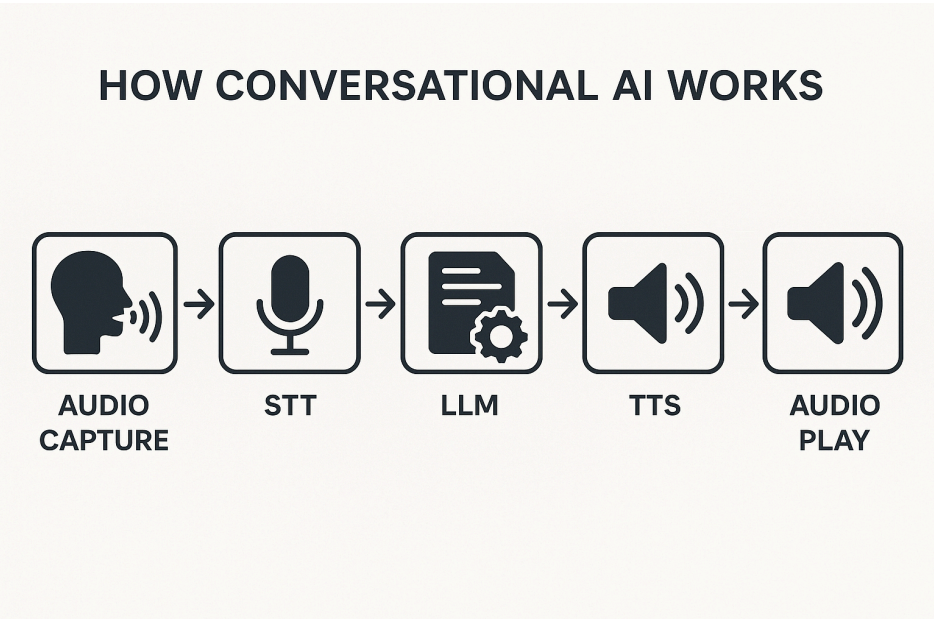
Example flow with LLM-powered assistant:
- User: “What’s the weather in London tomorrow?”
- ASR: Transcribes the question.
- LLM: Understands intent (get_weather), extracts entities (London, tomorrow), queries API.
- LLM: Generates response: “Partly cloudy with a high of 18°C.”
- TTS: Converts the text to natural speech.
The Future is Multimodal and Emotionally Aware
Next-gen conversational AIs will process not just text and voice, but also images and videos. Imagine showing a picture to your assistant and getting a descriptive answer. Emotional intelligence will also become key — enabling AIs to detect and respond empathetically to human emotions.
Conclusion
Modern conversational AI is built on a complex stack of cutting-edge technologies — from audio processing to neural language models. As these systems grow more advanced, our interactions with machines will become increasingly seamless and human-like. The AI revolution is already underway — and it's talking.
Written by
Siddharth Jhanwar
Conversational AI Engineer, Zoice
Siddharth Jhanwar is an engineer at Zoice focused on the LLM layer of conversational AI — function calling, context management, prompt design, and reliable tool use inside real-time voice and chat agents. He writes about the practical engineering behind making AI agents accurate, fast, and production-ready for Indian businesses.
Keep reading
All articles
Connect Plivo to Zoice: A Step-by-Step Guide to Putting an AI Agent on Your Phone Number
WhatsApp Business API Without a BSP: What Skipping the Middleman Actually Means
BYOC for Voice AI: Wiring Your Own SIP Trunks into AI Agents (and Why Telephony Margins Matter)
Ready to put an AI agent to work?
Deploy voice, WhatsApp, and chat agents across Indian languages — grounded in your knowledge and measured on every call.