AI EMI Reminder Calls: Collections That Stay Polite, Compliant and Multilingual
Shivansh Bhardwaj
AI Product & Systems Engineer
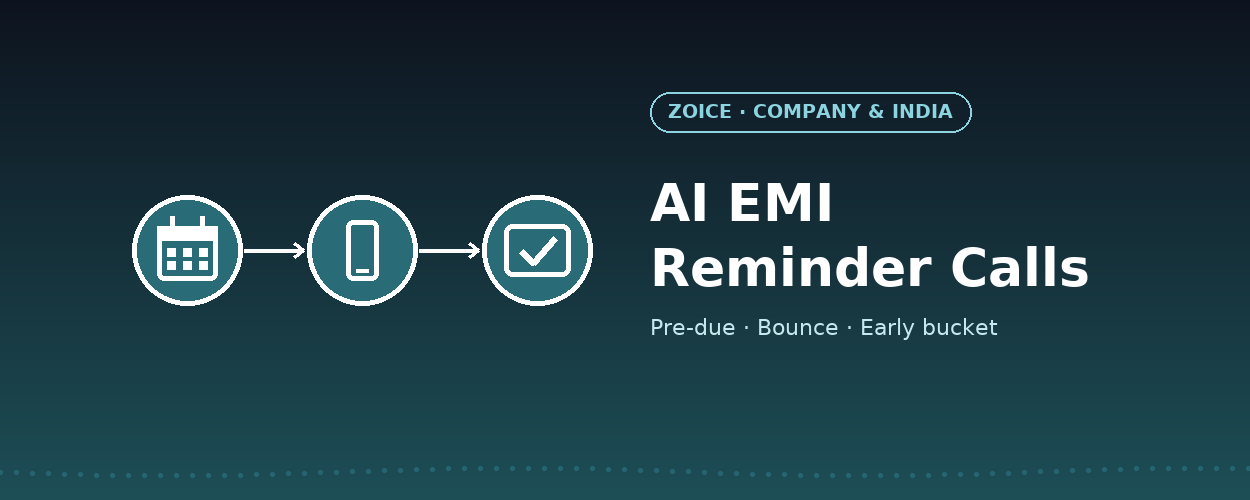
Many EMI defaults do not start as a decision to stop paying. A salary lands two days late, the account drops below the debit amount, and the NACH or e-mandate debit bounces. A borrower who meant to pay is now overdue, with a bounce charge on top. The cheapest moment to step in is before that happens, which is why AI EMI reminder calls are often the first thing collections heads want to automate.
Dialling is easy. The hard part is calling thousands of borrowers a day in their own language, saying only true things, never reaching the wrong person or hour, and leaving a record that survives an audit. An AI agent can be held to that on every call if the rules are designed in from the start. This post covers three reminder calls, the RBI and TRAI rules behind them as of October 2026, compliant call design, and where the Zoice collections setup fits.
Three Calls, Not One: Pre-Due, Bounce and Early Bucket
One campaign usually means one script: too aggressive for a borrower who has missed nothing, too vague for one who has. Split the work into three call types:
- Pre-due reminders go out a few days before the due date to a borrower who is up to date. They confirm the date and amount and offer a way to pay. The tone is service, not recovery.
- NACH bounce follow-ups start when the mandate debit fails, often before the borrower knows. The call explains what happened, states the amount accurately and asks for a committed payment date.
- Early-bucket soft collections cover accounts that have recently gone overdue. The call records the reason and a promise to pay, and passes hardship cases or disputes to a person.
RBI's recovery rules are written around overdue loans, so bounce and early-bucket calls fall clearly inside them, while a pure pre-due reminder may fall partly outside. That is a reading of the text, not settled guidance, so apply the stricter standard to all three.
The most-cited evidence is old and from a different setting: a 2011 randomised trial (NBER Working Paper 17020) with a Ugandan microlender, covering about 1,100 borrowers. Monthly SMS reminders sent three days before the due date raised the probability of on-time payment by 7–9%, similar to a 25% interest-rate cut. That says a well-timed nudge changes behaviour. It does not forecast results for an AI voice call in India in 2026.
Key Insight
AI EMI reminder calls work best as three campaigns: pre-due reminders, bounce follow-ups and early-bucket soft collections, each with its own script and hand-over rules. RBI's conduct rules apply whoever, or whatever, places the call, so build them into the agent: name the lender, confirm identity before mentioning dues, read amounts from the loan system, announce the recording and pass sensitive calls to a human.
On this page
The Rules: RBI Recovery Conduct and TRAI's 1600 Series
RBI: the rule today and the rule coming
The rule in force today is RBI's August 12, 2022 circular on recovery agents. It bars regulated entities and their agents from calling borrowers before 8:00 a.m. or after 7:00 p.m. to recover overdue loans, and makes the lender responsible for ensuring there is no intimidation or harassment of any kind. It covers commercial banks (excluding payments banks), all-India financial institutions, NBFCs including housing finance companies, co-operative banks and asset reconstruction companies; microfinance loans are excluded.
On August 6, 2026 RBI issued the Commercial Banks – Responsible Business Conduct Fourth Amendment Directions, 2026, with a full section on recovering loan dues. From 1 January 2027, contact is allowed only between 08:00 and 19:00 unless the borrower asks or authorises otherwise. Recovery calls must be recorded and kept for six months from the call date (until the case is disposed of if it is sub judice). Banks should tell the borrower the call is recorded, must document the time and number of calls, and must honour a request not to be called at a particular time.
The listed harsh practices include excessive calling or messaging, calls outside the prescribed hours, threatening or anonymous calls, false or misleading representations, and intimidating the borrower's relatives, referees, friends or co-workers.
The 2026 directions were issued on 6 August 2026 and take effect on 1 January 2027. Until then, the 2022 circular is the operative rule. Parallel directions were issued the same day for other lender types, so check the text for your category (NBFCs and HFCs have their own). The directions refer to an “employee / recovery agent” and, as far as we have found, do not mention AI. Treating an AI agent's calls as covered is an inference, but it is the only safe one.
TRAI: calls come from the 1600 series
TRAI's direction of November 19, 2025 made 1600-series numbers mandatory, in phases, for entities regulated by RBI, SEBI and PFRDA, and a direction dated December 16, 2025 extended this to IRDAI-regulated entities. All phase deadlines have passed, according to Outlook Business: commercial banks on 1 January 2026; large NBFCs, payments banks and small finance banks on 1 February; remaining NBFCs and smaller banks on 1 March. The aim is to curb impersonation fraud, so a reminder from an ordinary mobile number now looks like a scam.
As design requirements (an engineering reading, not legal advice; have compliance sign it off):
| Rule | What the agent must do |
|---|---|
| Calling window (8 a.m.–7 p.m. today; 08:00–19:00 under the 2026 directions from 1 January 2027) | Block dials and retries outside the window; drop missed attempts rather than pushing them into the evening. |
| Honour requests not to call at certain times | Save the request on the borrower's record and feed it into scheduling. |
| Record, keep six months, tell the borrower (required from 1 January 2027; build it now) | Give the recording notice in the opening lines; set retention to at least six months. |
| No excessive calling; document the time and number of calls | Log every attempt and enforce an attempt cap you set as policy. The directions set no number. |
| No anonymous calls | Name the lender in the first sentence and call from a 1600-series number. |
| No false or misleading representations | Take amounts and consequences from your loan system, never from generated text. |
| Dues discussed only with the borrower or guarantor | Confirm identity before stating any amount. |
RBI's FREE-AI committee report (13 August 2025) recommends that consumers be “explicitly informed whenever they are interacting with AI systems”, with the option to switch to a human. It is advisory, not binding, but one sentence of disclosure costs nothing.
Recording also raises a data-protection question. Call recordings and transcripts hold borrowers' voices and personal data, which brings them under India's Digital Personal Data Protection Act, 2023, so review the notice you give, the purpose you record for and how long you keep the data with counsel.
Core Components
- 1
Campaign Segmentation
Pre-due reminders, NACH or e-mandate bounce follow-ups and early-bucket soft collections run as separate campaigns. Each has its own trigger, script, tone and success measure.
- 2
Identity and Disclosure Opening
Every call names the lender, says why it is calling, discloses that the caller is an AI and tells the borrower the call is recorded. The agent confirms it is speaking to the borrower or guarantor before mentioning any amount.
- 3
Grounded Dues and Approved Consequences
Amounts, due dates and charges come from variables in your loan system, not from generated text. The agent can state only consequences from a pre-approved list that legal has reviewed.
- 4
Calling Window and Attempt Policy
The scheduler blocks every dial and retry outside the permitted hours and respects times the borrower has asked you not to call. It applies a per-borrower attempt cap that you set as policy.
- 5
Escalation and Audit Trail
Bereavement, medical emergencies, disputes and hardship requests go to a human. Every call leaves a recording, a transcript and logged outcome fields for audit.
Designing an AI EMI Reminder Call That Stays Polite
Compliance is mostly decided by a call's structure. This order works for all three call types:
- Name the lender, the reason for the call, and that it is an automated assistant: “I'm an automated assistant calling from [lender] about your home loan EMI.”
- Say in one line that the call is recorded.
- Confirm identity before mentioning any amount. Use a light second check, such as the last four digits of the loan account, rather than relying on a spoken 'yes'. If someone else answers, end politely without mentioning dues and log a callback.
- State the facts from system data (amount, due date, a failed mandate debit), then ask for a payment date or preferred way to pay.
- Close with a short summary and tell the borrower how to reach a person.
Where generated language must stop
The quickest way for a language model to break a conduct rule is to make up a consequence. Lines like “your credit score will be ruined” or “legal action starts tomorrow” may be false for that account, and false or misleading representations are on RBI's list of harsh practices. Pull amounts, dates, charges and consequences from your loan system, let the agent use only consequence lines legal has approved, and let it be warm and conversational everywhere else.
Branches that belong to a human
The 2026 directions say recovery contact must avoid inappropriate occasions such as bereavement in the family, medical emergencies or other calamitous occasions. On any mention of these, the agent should apologise, drop the payment request and flag the account for a person, as it should for disputes, fraud claims, hardship requests outside your authorised options and obvious distress.
RBI's directions do not require a calling language, so multilingual collection calls are good practice rather than law, but a borrower who cannot follow the recording notice or the amount has not really been informed. Store each borrower's preferred language, start the call in it, and let the agent follow if the borrower switches, including mixed speech such as Hinglish.
Implementation Roadmap
- 1Split your portfolio into pre-due, bounce follow-up and early-bucket segments, and store each borrower's preferred language and any times they have asked not to be called
- 2Have compliance and legal approve the opening disclosure, the identity check, the recording notice and a fixed list of consequence statements the agent may use
- 3Configure the calling window, a per-borrower attempt cap and recording retention of at least six months before the first dial
- 4Define the conditions that send a call to a human (bereavement, medical emergency, dispute, fraud claim, hardship outside the approved options) and test each one on recorded calls
- 5Launch one segment first, review transcripts and outcome fields every week, and only then extend to the bounce and early-bucket campaigns
Running AI EMI Reminder Calls on Zoice
On Zoice, AI phone calls run outbound campaigns from a CSV, and each contact can be given their own language. Agents speak Hindi, Bengali, Gujarati, Kannada, Malayalam, Marathi, Odia, Punjabi, Tamil, Telugu and English (India), support Hinglish natively and follow a mid-call language switch (see language support).
Collection agents are configured around approved calling hours, prohibited harassment language and mandatory disclosure scripts. Outbound calls can capture an explicit yes/no consent in the first 5 seconds, and calls are stored as encrypted, tamper-evident recordings with timestamps, agent ID and outcome. Compliance monitoring checks every call against your script and flags deviations in real time, and hallucination detection flags responses not grounded in your knowledge base. Set the recordings retention window to cover your required period; Aadhaar, PAN and OTP patterns can be redacted before transcripts are stored (see security).
Within limits you define, the agent can offer EMI breakdowns, record payment-date commitments and sync agreed terms to your collections system, with fields such as promised payment date or reason for delay on every call. The transfer_number tool passes human-branch calls to a person with an optional announcement, and supervisors can whisper to the agent or take over. If your 1600-series numbers run on your own carrier's SIP trunk, SIP/BYOC calling lets you assign them to AI agents; confirm provisioning with your carrier first. Script sign-off, the attempt cap and which RBI directions apply remain your responsibility.
Frequently Asked Questions
Can a bank or NBFC legally use AI EMI reminder calls?
The RBI recovery rules referred to here neither mention nor prohibit AI or automated calls; they regulate conduct. Hold an AI agent to the same rules as a human telecaller (calling hours, civility, honesty, no anonymous calls) and call from your 1600-series numbers.
What hours can lenders call borrowers?
Under the 2022 circular in force today, recovery calls may not be made before 8:00 a.m. or after 7:00 p.m. From 1 January 2027, the 2026 directions for commercial banks keep 08:00–19:00 unless the borrower expressly asks or authorises otherwise. Apply the window to pre-due reminders too.
Do collection calls have to be recorded?
From 1 January 2027, the directions for commercial banks require recovery calls to be recorded and kept for six months (longer if the case is sub judice), with the borrower told the call is recorded. Build this in now.
Should borrowers be told they are speaking to an AI?
Yes, as good practice. RBI's FREE-AI report is not binding, but one line of disclosure costs nothing.
Planning reminder and soft-collections campaigns? Talk to our team and bring your segments and approved scripts.
Sources
- Reserve Bank of India (Commercial Banks - Responsible Business Conduct) Fourth Amendment Directions, 2026 — Reserve Bank of India
- Outsourcing of Financial Services - Responsibilities of regulated entities employing Recovery Agents — Reserve Bank of India
- Framework for Responsible and Ethical Enablement of Artificial Intelligence (FREE-AI) in the Financial Sector – Committee report — Reserve Bank of India
- TRAI issues Direction mandating phase-wise adoption of 1600-series by BFSI sector entities (PIB, 19 Nov 2025) — Press Information Bureau, Government of India
- TRAI Sets Firm Deadlines For BFSI Entities To Adopt '1600' Series For Service, Transactional Calls — Outlook Business
- Remembering to Pay? Reminders vs. Financial Incentives for Loan Payments — National Bureau of Economic Research
Written by
Shivansh Bhardwaj
AI Product & Systems Engineer
Shivansh Bhardwaj is an AI Product & Systems Engineer at Zoice, focused on building and scaling production-grade AI products and conversational systems. His work spans AI agent architecture, real-time voice pipelines, LLM orchestration, latency optimisation, and multilingual AI experiences. He writes about emerging AI technologies, engineering challenges, and practical approaches to building fast, reliable, and scalable AI products for real-world business use cases.
Keep reading
All articles
Ready to put an AI agent to work?
Deploy voice, WhatsApp, and chat agents across Indian languages — grounded in your knowledge and measured on every call.