AI Voice Agent vs IVR: Why “Press 1” Menus Are Falling Behind
Vicky Yadav
Backend & AI Systems Engineer, Zoice
A caller spots a double charge on last month’s bill and rings the helpline. The menu says: “For billing, press 1. For a new connection, press 2. To hear these options again, press 9.” Nothing fits, so they press 0 repeatedly, or hang up.
This article is for teams deciding whether to replace an IVR (interactive voice response, the “press 1” phone menu) with an AI voice agent.
What Changes When Callers Can Just Say the Problem
- Menu IVR: digits move the caller through a fixed prompt tree.
- Speech-enabled IVR: the caller speaks, and keywords or a few predefined intents drive a fixed flow.
- Conversational IVR (often sold as AI-powered IVR): natural-language understanding picks the intent, often then routing into predefined flows.
- AI voice agent: holds a multi-turn conversation, calls backend systems, completes tasks and hands over with context.
The first three suit a handful of well-understood requests, but designers must anticipate every path, so a caller with two issues, or one who describes the problem in their own words, often falls outside the flow. An AI voice agent works from the conversation, so it can resolve requests no branch was built for. Some products sold as “conversational IVR” only replace the first menu, so ask vendors which one you are buying.
Key Insight
Replacing an IVR rarely means replacing your telephony: the carrier, numbers, SIP trunks and keypad input for PINs can all stay. What changes is the menu tree. The hard engineering is response speed and language coverage, and the real test of success is outcomes such as resolution and containment, not the number of calls the AI handled.
On this page
How Fast an AI Voice Agent Has to Answer
Most production voice agents are a chain. The Moshi paper describes voice activity detection, speech recognition, a text dialogue model and text-to-speech, and each stage adds delay: speech-to-text (STT) waits for the caller to finish, the language model (LLM) takes time to reply and may call tools, text-to-speech (TTS) produces audio, and the network adds time on every hop.
Human turn-taking is a reference point, not a target
In a ten-language study, Stivers and colleagues found that the most common gap between turns was 0 to 200 ms in every language, with an overall mode of 0 ms and a mean of +208 ms. That describes people taking turns with each other. It is not a latency requirement for AI voice agents, and it is not end-to-end response time, which includes every stage above.
The Moshi authors say cascaded pipelines cause “a latency of several seconds between interactions”, while their full-duplex research model reports 160 ms theoretical and 200 ms in practice. That is a research result, not a phone-line guarantee: PSTN (phone network) or SIP (internet telephony) transport and codecs add delay. How fast is fast enough depends on the interaction, the architecture and the caller’s experience.
Commercial models also change quickly: OpenAI made its Realtime API generally available with gpt-realtime on 28 August 2025, and its deprecations page now lists gpt-realtime for shutdown on 20 January 2027, with gpt-realtime-2.1 as the replacement. Check current model lists before you commit to one.
One Caller, Two Systems: Menu IVR vs AI Voice Agent
Take the double-charge caller through both systems (an illustration, not a measured result). On a menu IVR, they guess “billing”, press 1, and meet a second menu where nothing says “I was charged twice”, so they press 0 and wait for a human. With an AI voice agent, they say it in their own words, and the agent asks for what is missing, checks the account, then answers or hands over with context.
Multilingual AI voice agents for code-mixed callers
A “press 1 for Hindi, 2 for English” menu assumes one language per call, but many Indian callers switch mid-sentence: “mera refund abhi tak process nahi hua, can you check the status?” Keyword menus handle that poorly, as do models trained on clean, single-language audio.
Sarvam’s models show why the version matters. Each word error rate (WER) below is vendor-reported, tied to one model and benchmark, and not comparable across rows:
| Model | Status in Sarvam’s docs | Reported result | Benchmark |
|---|---|---|---|
| Saarika v2.5 | Being deprecated | 18.32% WER across 11 languages | VISTAAR |
| Saaras v3 | Previous model, still available | About 19% WER | IndicVoices |
| Saaras v4 | Latest, default, recommended | Lowest WER reported, 16.03%, in the keyword-prompting (L5) setting with a domain keyword list supplied | IndicContextEval |
Statuses: Sarvam’s model list and Saarika page; figures: Saaras v3 and v4 launch posts. Test recognition on your own recorded calls before going live. Zoice agents speak ten Indian languages, including Hindi, Tamil and Telugu, plus English (India), with native Hinglish (Hindi mixed with English) support and mid-conversation language switching; see the language support page.
Implementation Roadmap
- 1Pull a month of IVR logs and recordings, and rank call reasons by volume and by how often each ends with a human
- 2Test speech recognition on your own recorded calls, in every language and code-mixed pattern your callers use
- 3Replace only the top-level menu with an open “How can I help?” prompt that routes into your existing queues
- 4Automate the highest-volume routine intent end to end, with keypad entry for PINs and OTPs and clear handoff rules
- 5Review the KPIs against your IVR baseline, fix what fails, then move to the next intent
How to Replace the Menu Without Replacing Your Telephony
Replacing the IVR is a menu project, not a telephony project. The carrier, the numbers customers dial, the SIP trunks and keypad handling can all stay (see diagram).
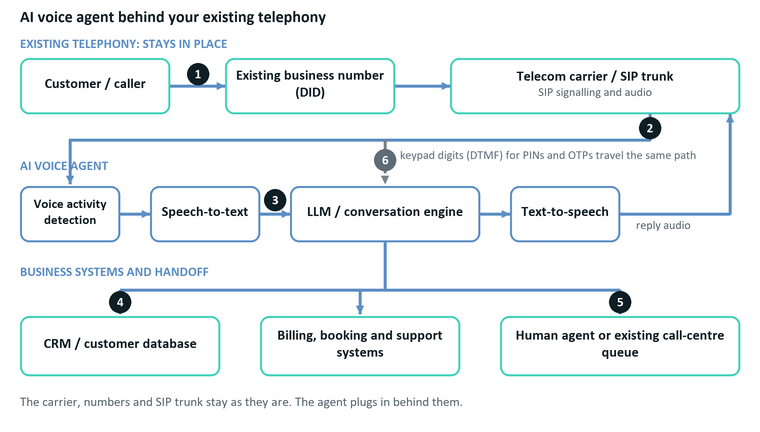
- The caller dials your existing business number (DID).
- The call reaches the AI voice agent over your carrier’s SIP trunk.
- One pipeline detects speech, transcribes, reasons and speaks.
- The agent calls backend systems such as CRM or billing.
- It resolves the request or transfers to a human queue.
- Keypad (DTMF) input stays available.
Keep the keypad for PINs and OTPs
DTMF tones (the tones a keypad press sends) are carried as signalling events under RFC 4733, which gives “a gateway passing DTMF tones to an IVR” as an example of digits that must arrive reliably. Low-rate voice codecs cannot be guaranteed to reproduce the tones accurately enough for automatic recognition, so events are usually the more dependable path. In Dialogflow CX, with DTMF enabled, keypresses become normal text input.
Check signalling and media encryption separately
SIP, the protocol that sets up calls, can run over UDP, TCP or TLS. TLS protects the SIP signalling, the call-setup messages. The audio travels separately as RTP, and SRTP is what protects that media stream (RFC 3711; Twilio also treats them as separate protections). So a TLS trunk does not by itself guarantee encrypted audio: verify SRTP negotiation and configuration independently, because the right setup depends on your telephony provider and SIP architecture. On Zoice, SRTP media encryption is available when the trunk uses TLS.
Migrate one request at a time
Replace the top-level menu with an open prompt that routes into your existing queues, then automate the highest-volume requests one at a time. According to Twilio’s documentation, ConversationRelay converts caller speech into text for your application, which generates the reply using AI; Twilio then speaks that reply to the caller. Set handover rules for callers who ask for a person, repeat a failed request or are clearly distressed, and for requests outside policy.
On Zoice, you can bring your own carrier (BYOC): register SIP trunks over UDP, TCP or TLS, choose a DTMF mode per trunk, and bind each DID (phone number) to an AI voice agent. transfer_agent passes a call to another AI specialist and transfer_number to a human phone number, with an optional announcement; see the SIP / BYOC page. Because call audio passes through speech and language models, where it is processed is a compliance question; our data residency post covers it.
Measure Outcomes, Not Calls Handled
A count of calls the AI answered says little, since badly handled calls still count. Measure IVR automation by outcomes against your current baseline, and read containment alongside abandonment, since callers who give up can look like resolved calls.
| KPI | What it measures |
|---|---|
| Call containment rate | Calls resolved without a human |
| First call resolution (FCR) | Issues resolved first time |
| Average handling time (AHT) | Average time per interaction |
| Transfer rate | Calls passed to human agents |
| Cost per resolved call | Operating cost divided by resolved calls |
| Abandonment rate | Callers who hang up before resolution |
| Task completion rate | Intended tasks completed |
| Customer satisfaction (CSAT) | Satisfaction after the call |
A hypothetical example, with made-up numbers: if your IVR resolves 40 of every 100 calls without a human and a pilot resolves 55, containment is up 15 points; also check transfer rate, abandonment and CSAT, and compare cost per resolved call.
A Published Deployment: Kaushgar Setu’s Helpline
According to Zoice’s customer stories, Kaushgar Setu’s helpline runs on a Zoice voice bot that identifies callers from their number, reads out their wallet balance and training status, and files SLA-tracked support tickets without a human picking up. This post does not quote results for this deployment.
How to Decide: Keep the Menu or Add an Agent
A menu IVR can still be the right tool. Use these checks:
- Keep the menu when callers have a few well-understood reasons for calling.
- Add an agent when call reasons vary, callers raise several issues or mix languages, or you need transcripts to learn why people ring.
- Either way, keep keypad entry for PINs and OTPs, and replace only the top-level menu first.
Frequently Asked Questions
Is an AI voice agent cheaper than an IVR?
Per call, an IVR costs less, but compare cost per resolved call: an AI voice agent costs more per minute and can finish requests an IVR can only route. We could not verify the widely repeated analyst forecasts of contact-centre savings from a primary source, so model your own. On Zoice, each conversation shows its cost in ₹ with a per-minute breakdown; see the pricing page.
Can an AI voice agent take a PIN or OTP on the keypad?
It should, and for secrets the keypad is often better, since a spoken OTP ends up in the transcript. On Zoice, recording redaction can also strip Aadhaar, PAN and OTP patterns before transcripts reach storage.
Is conversational IVR the same as an AI voice agent?
Not always. Test any product with three questions: can a caller raise two issues in one sentence and get both handled, can the system act through your back end or only route, and what happens when the caller goes off-script? A product that only routes is a better front door, not an agent.
Can an AI voice agent understand callers on a bad phone line?
It depends on the recognition model, so test it on recordings from your real callers, since phone audio is narrowband and often noisy. Zoice adds caller-side noise suppression.
Bring a month of IVR logs and your top call reasons, and we will help you pick the first request to automate. Talk to our team.
Sources
- Universals and cultural variation in turn-taking in conversation — Proceedings of the National Academy of Sciences (via PubMed Central)
- Moshi: a speech-text foundation model for real-time dialogue — arXiv (Kyutai)
- Introducing gpt-realtime and Realtime API updates for production voice agents — OpenAI Developer Community
- Deprecations — OpenAI API documentation
- Speech-to-text models — Sarvam AI Docs
- Saarika | Sarvam AI Docs — Sarvam AI
- Saaras V3 (Sarvam ASR blog) — Sarvam AI
- Introducing Saaras V4 speech recognition — Sarvam AI
- RFC 4733: RTP Payload for DTMF Digits, Telephony Tones, and Telephony Signals — IETF / RFC Editor
- RFC 3711: The Secure Real-time Transport Protocol (SRTP) — IETF / RFC Editor
- Elastic SIP Trunking | Twilio Docs — Twilio
- DTMF for telephony integrations | Dialogflow CX — Google Cloud
- ConversationRelay | Twilio Docs — Twilio
Written by
Vicky Yadav
Backend & AI Systems Engineer, Zoice
Vicky Yadav is a Backend & AI Systems Engineer at Zoice, focused on building and scaling the engineering systems behind conversational AI products. He works across backend services, APIs, telephony integrations, real-time voice workflows, and production infrastructure, with a focus on making AI-powered systems reliable, scalable, and production-ready for real-world use cases.
Keep reading
All articles
Built in India, Hosted in India: What Data Residency Actually Means for a Voice Stack
AI EMI Reminder Calls: Collections That Stay Polite, Compliant and Multilingual
AI Telecaller for Real Estate: Qualifying Every Lead Before Your Sales Team Starts
Ready to put an AI agent to work?
Deploy voice, WhatsApp, and chat agents across Indian languages — grounded in your knowledge and measured on every call.