Network Transport in Conversational AI: The Unsung Hero of Voice Interactions
Siddharth Jhanwar
Conversational AI Engineer, Zoice

In the world of Conversational AI, much attention is paid to large language models (LLMs), speech recognition, and text-to-speech synthesis. But beneath the surface lies a critical yet often overlooked component: network transport.
Whether you're building a smart assistant, a customer support bot, or an interactive voice-based healthcare application, your system’s responsiveness and reliability hinge on how audio and data traverse the network.
This post dives deep into the various protocols and architectural patterns used in voice AI systems, focusing on WebSockets, WebRTC, HTTP, QUIC, and network routing — and why the right choices here can make or break the user experience.
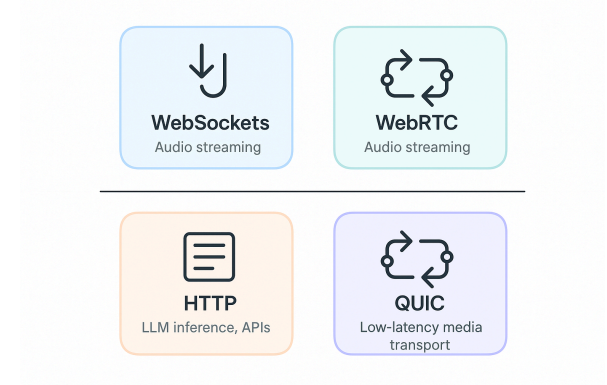
WebSockets vs WebRTC: Choosing the Right Pipe for Audio
WebSockets: Good Enough for Prototypes, Not Real-Time Voice
WebSockets offer a persistent, full-duplex communication channel over TCP. They are easy to implement and widely supported, making them a go-to choice for developers experimenting with voice AI.
- TCP & Head-of-Line Blocking: A single delayed packet can block all subsequent packets — a killer for real-time audio.
- Latency Accumulation: Without packet dropping or jitter handling, delays stack up quickly.
- Poor Media Observability: No native tools for monitoring audio quality.
- Complex Reconnection Logic: Requires significant custom logic for resilience.
Key Insight
While LLMs and speech synthesis often get the spotlight, real-time voice AI depends critically on network transport — from WebRTC to QUIC. This blog dives into protocols, latency strategies, and why WebRTC still dominates production pipelines.
On this page
WebRTC: Designed for Real-Time Media
- Uses UDP: Allows out-of-order delivery, supports low-latency audio.
- Opus Codec Integration: Enables error correction, bandwidth estimation, and dynamic pacing.
- Built-in Timestamps: Simplifies playout and interruption handling.
- Robust Enhancements: Includes echo cancellation, noise suppression, gain control.
- Telemetry: Real-time stats allow precision media tuning.
✅ Use WebRTC if latency and audio quality matter — ideal for browsers and mobile voice AI clients.
HTTP: The Workhorse for Text & Control
While HTTP isn't ideal for audio streaming, it is crucial in other voice AI tasks:
- Text-based Inference: Send transcripts via REST to LLMs.
- Service Integration: HTTP connects to CRMs, EMRs, etc.
- Function Proxying: Calls offloaded to HTTP endpoints decouple core logic.
Limitations:
- Latency from TLS handshake adds 100ms+
- No support for media streaming
- Inefficient binary handling (base64 bloat)
Conclusion: HTTP is essential — just not for low-latency audio.
Core Components
- 1
WebSockets vs WebRTC
Compare WebSockets (great for prototypes) vs WebRTC (purpose-built for real-time audio) in terms of latency, reliability, and media quality.
- 2
HTTP and QUIC in Voice AI
While HTTP powers inference and APIs, QUIC brings the next generation of low-latency transport, fusing speed and encryption.
- 3
Network Routing and Latency
Routing through edge servers and private backbones is crucial to reduce jitter and ensure consistent voice interactions globally.
- 4
Latency Benchmarks
Understand RTT differences across geographies and how they affect 1-second latency budgets in conversational flows.
- 5
Protocol Use Cases
Learn when to use WebRTC, WebSockets, HTTP, or QUIC depending on your voice AI architecture goals.
QUIC: The Next-Gen Transport for Real-Time AI
QUIC (Quick UDP Internet Connections), developed by Google and powering HTTP/3, merges TCP features with UDP speed:
- Multiplexed Streams (no Head-of-Line Blocking)
- Fast connection setup
- Built-in encryption
- Bidirectional communication
⚠ Caveat: Browser support varies (e.g., Safari lacks full WebTransport). But standards like Media over QUIC (MoQ) are progressing fast.
Network Routing: Proximity Matters More Than You Think
Even with the best stack, long-haul connections hurt latency:
- UK ↔ California RTT ≈ 140ms
- UK ↔ London RTT ≈ 15ms
That’s a 10x difference — critical for sub-second voice interaction.
- Edge Servers: Deploy close to users (like CDNs).
- Private Backbones: Avoid public internet congestion.
- Jitter Buffers: Compensate for delayed packets but add lag.
Implementation Roadmap
- 1Use WebRTC for real-time voice transmission with low jitter and echo control
- 2Leverage HTTP for LLM requests and external API calls
- 3Experiment with QUIC for future-proofing your real-time media stack
- 4Deploy edge servers to reduce RTT and improve audio responsiveness
- 5Design routing-aware architectures to ensure consistent performance across regions
Summary: Which Protocol When?

Architecting for the Real World
Modern conversational apps mix multiple protocols:
- WebRTC for real-time audio
- HTTP for LLMs and services
- QUIC as a future-ready solution
- Use edge and private networks to ensure stability
Final Thought
It’s tempting to focus on the “intelligence” in Conversational AI. But speed, reliability, and transport intelligence matter just as much. Network transport is the hidden backbone of great voice experiences.
Written by
Siddharth Jhanwar
Conversational AI Engineer, Zoice
Siddharth Jhanwar is an engineer at Zoice focused on the LLM layer of conversational AI — function calling, context management, prompt design, and reliable tool use inside real-time voice and chat agents. He writes about the practical engineering behind making AI agents accurate, fast, and production-ready for Indian businesses.
Keep reading
All articles
Built in India, Hosted in India: What Data Residency Actually Means for a Voice Stack
AI EMI Reminder Calls: Collections That Stay Polite, Compliant and Multilingual
AI Telecaller for Real Estate: Qualifying Every Lead Before Your Sales Team Starts
Ready to put an AI agent to work?
Deploy voice, WhatsApp, and chat agents across Indian languages — grounded in your knowledge and measured on every call.